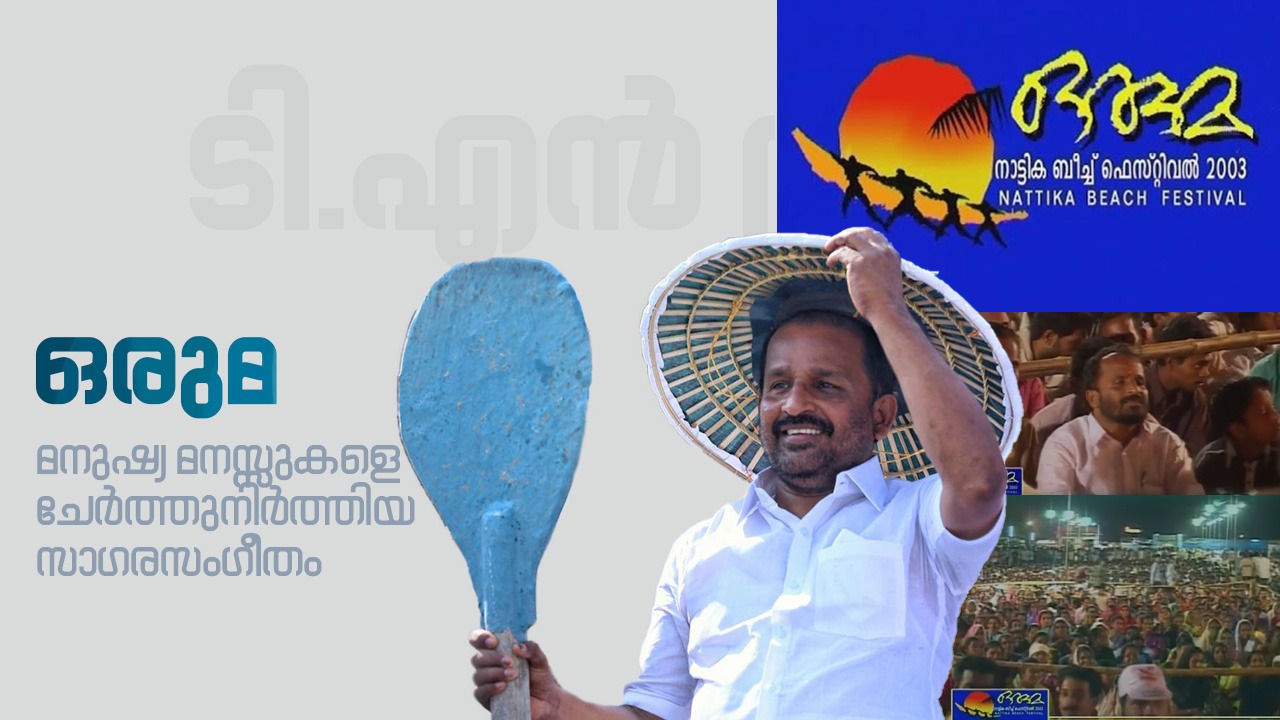
Oruma Beach Festival: Waves of Unity, Shores of Harmony
Oruma Beach Festival, Celebrating Unity Along the Shores
The Marad riots of 2003 left one of the deepest wounds in Kerala’s social history. Coastal communities that had lived for generations in harmony were suddenly divided along religious lines. The shores — once symbols of coexistence, where Hindus, Muslims, and Christians worked together on the same fishing boats and shared rituals, festivals, and livelihoods — fell under an atmosphere of fear and separation. It was in response to this painful rupture that Oruma was born.
Envisioned by T. N. Prathapan, Oruma emerged as a cultural movement to restore the spirit of togetherness that the sea had long nurtured among coastal people. Conceived as a beach festival promoting unity beyond religion and caste, Oruma became a public platform where diversity was celebrated as strength.
The festival’s logo designed by renowned artist Vinaylal depicts people holding hands under the hues of a setting sun, symbolizing collective effort, much like fishermen pushing a boat ashore. Even the typography of “Oruma” was crafted to visually express togetherness.
Poet Kaithapram Namboothiri embraced the idea wholeheartedly and penned the festival’s theme song, composed by his son and performed by 101 children. Literary icon Sukumar Azhikode hailed Oruma as a cultural necessity of the time.
The first Oruma Beach Festival was held in 2003 at Nattika Beach and marked a powerful revival of coastal pluralism. It inspired similar inclusive celebrations across Kerala’s shoreline.
Oruma is not merely a festival. It is a declaration that unity is the natural language of the sea, and that the bonds between people are stronger than the forces that seek to divide them.
Oruma — where the coast comes together as one.